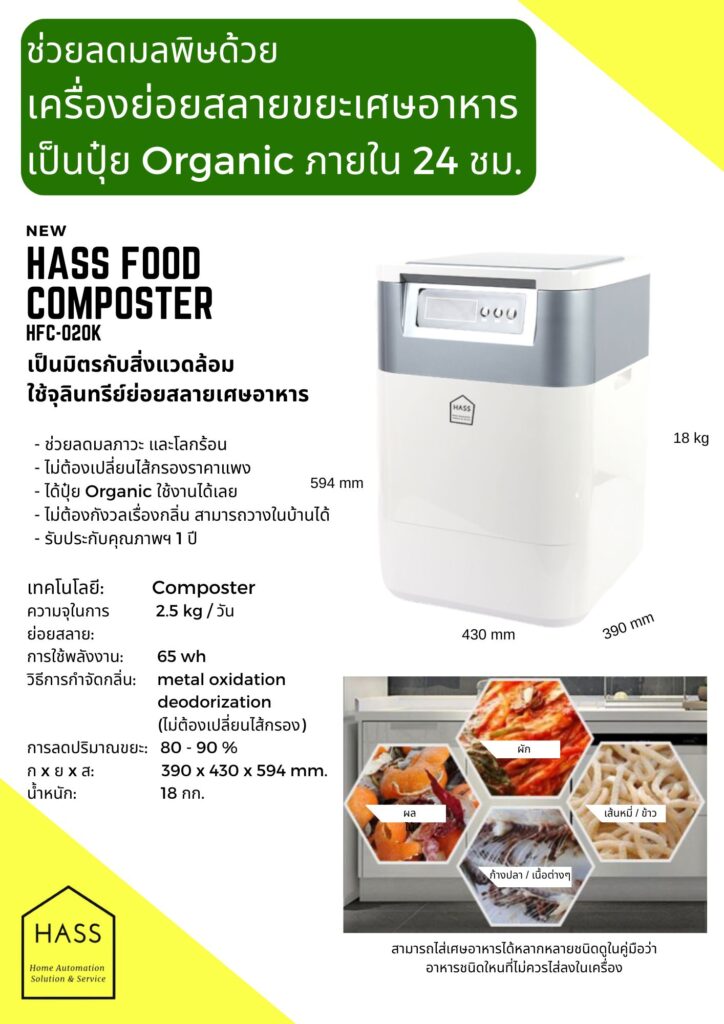
HASS Food Composter (Model HFC-020K)
A larger-capacity microbial food waste composter, designed for households of 4–9 people. Converts waste into organic fertilizer within 24 hours, with no need to worry about expensive filter replacements.
Key Features:
- High Capacity: Processes up to 2.5 kg of food waste per day, ideal for larger households.
- Natural Decomposition System: Utilizes genuine microbial composting (Compost), not just drying.
- Long-Term Cost Savings: Very low running costs, as filters do not require replacement every 3 months.
- High-Efficiency Odor Elimination: Employs UV, Ozone, and Metal Oxidation systems to break down odor molecules.
- Modern Design: Features a clear function display screen and premium, durable materials.
- Quiet Operation: Low noise level allows placement in the kitchen without disturbing rest.
Technical Specifications:
- Capacity: 2.5 kg/day
- Power: 60W (200V/50–60Hz)
- Dimensions: 39 × 43 × 59.4 cm
- Weight: 18 kg
- Warranty: 1 year
Frequently Asked Questions
Does it use a lot of electricity in Thailand? (Specifically addressing the 24/7 operation concern)
Fair but Focused Answer: No, it does not use a lot of electricity. The HASS HFC-020K is designed for energy efficiency, which is a crucial consideration for 24/7 appliances in Thailand. It operates on a principle of aeration and mixing rather than high-heat drying or grinding.
- Power Consumption: It consumes approximately 25-35 Watts during its active mixing cycles. It does not run the motor continuously at full power. Think of its energy use as comparable to a small, energy-efficient desk fan.
- Cost Estimate: Based on the current Thai electricity tariff (approx. ฿4.2/unit), running the composter 24/7 would cost roughly ฿25 - ฿35 per month. This is a very manageable addition to your utility bill for the convenience it provides.
- Local Support: As a Raakdin product, the HASS HFC-020K is built for the Thai market and climate. You benefit from local engineering that prioritizes sensible energy use and comes with a reliable 2-year warranty and accessible local service support.
Can I put hard waste like chicken bones or durian seeds in this model?
Fair but Focused Answer: We do not recommend it. The HASS HFC-020K is optimized for processing typical kitchen food scraps through microbial decomposition and mechanical mixing.
- Chicken Bones: Small, soft bones (like from fish or very small poultry) may eventually break down, but larger, dense chicken bones will not decompose effectively. They can also potentially damage the mixing mechanism over time and create an inconsistent texture in the final output.
- Durian Seeds: Absolutely not. Durian seeds are extremely hard and dense. They will not break down in this type of composter and pose a high risk of jamming or damaging the internal auger/mixer.
- Best Practice: For the health of your machine and the best compost quality, stick to fruit/vegetable peels, cooked food leftovers (without large bones), coffee grounds, tea bags, and small eggshells. For hard bones and seeds, traditional disposal or an industrial-grade grinder is more appropriate.
What is the output like? Is it real fertilizer or just dried waste?
Fair but Focused Answer: The output is dehydrated and partially composted organic matter, which is an excellent soil amendment but not a complete, ready-to-use fertilizer on its own.
- The Process: The HASS HFC-020K uses a combination of heat (from the decomposition process, not a heating element), aeration, and mixing to accelerate natural breakdown. It reduces volume by about 90% and eliminates odors and pathogens through sustained microbial activity.
- The Output: You get a dry, crumbly, and stable material that looks like coarse coffee grounds or dry soil. It is not just sun-dried waste; it is biologically active and rich in beneficial microbes.
- Is it Fertilizer? Think of it as a powerful "compost starter" or soil conditioner. It is high in organic matter and improves soil structure, water retention, and microbial life. For use as a direct fertilizer, it is best to:
- Cure it: Mix the output into a traditional outdoor compost bin/pile for 2-4 weeks to finish the process.
- Bokashi Post-Process: Bury it directly in a garden bed or planter, where it will complete its decomposition and enrich the soil.
- Dilute it: Mix it with regular garden soil (e.g., 1 part composter output to 3-4 parts soil) for potting plants.
In summary: The HASS HFC-020K provides a convenient, hygienic, and odor-free way to process daily food waste into a valuable pre-compost. With the included 2-year warranty and local Raakdin support, it's a practical solution for Thai households looking to reduce waste meaningfully.