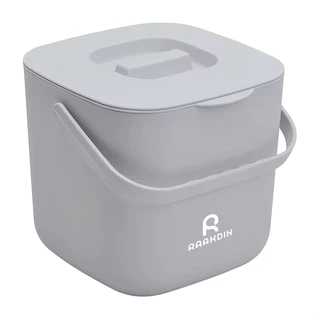
Raakdin Food Waste Separation Bin
Your essential starting point for household waste management. Designed to efficiently separate food scraps from general waste, it helps prevent odors and pests in the kitchen.
Key Features:
- Smart Waste Separation System: Engineered to effectively partition dry waste from wet waste (food scraps).
- Tight-Sealing Lid: Effectively blocks unpleasant odors and keeps insects out.
- Portable Design: Built-in handles make it easy to carry for disposal or cleaning.
- Elegant Aesthetics: Cute, modern shape available in 6 colors (Beige, White, Light Gray, Dark Gray, Green, Pink).
- Premium Material: Made from durable, easy-to-clean PP plastic.
Product Specifications:
- Total Capacity: 7 liters
- Inner Bin Capacity (for food waste): 4 liters
- Dimensions: 21 x 21 x 20.5 cm
- Weight: 524 grams
- Material: PP plastic
Frequently Asked Questions
Does it use a lot of electricity in Thailand? (24/7 operation concern)
This is a very common and important question, especially given Thailand's electricity costs. The Raakdin Food Waste Separation Bin is a manual separation model. This is the key point: it does not use any electricity at all. There is no heating element, no grinder, and no fan that needs to be plugged in 24/7.
- How it works: You manually separate the liquid from the solid food waste using the built-in strainer basket. The liquid is collected and can be diluted to make a nutrient-rich "liquid fertilizer" for plants. The solid waste remains in the bin, where a natural fermentation process (using bokashi bran or similar microbial inoculants) breaks it down. This process is entirely biological and requires no power.
- Benefit for Thailand: This makes it incredibly economical to run. You save on your monthly electricity bill, and it's not affected by power outages. It's a simple, sustainable solution perfect for the Thai household looking to reduce waste without increasing energy consumption.
For Raakdin users: You can enjoy this zero-energy operation with the added peace of mind of a 2-year warranty and readily available local support in Thailand for any questions about the process or parts.
Can I put hard waste like chicken bones or durian seeds in this model?
Short, honest answer: No, you should not.
The Raakdin is designed for fermentation, not decomposition or grinding. Here’s why hard items are not suitable:
- Process Limitation: The fermentation process works best on organic matter that microbes can easily penetrate and break down. Hard, dense materials like bones, durian seeds, or large mango seeds ferment extremely slowly, if at all.
- Space & Efficiency: These items take up a lot of space in your bin without contributing meaningfully to the output. You'll fill the bin up quickly with material that won't convert.
- Best Practice: For items like chicken bones, seafood shells, and large fruit seeds, the recommended disposal method in Thailand remains traditional (e.g., general waste or, for some, burying in a garden if you have space). The Raakdin excels at processing all your soft kitchen scraps: fruit peels, vegetable ends, cooked rice, coffee grounds, eggshells (crushed), and leftover food without large bones.
Tip: Crushing eggshells and chopping larger vegetable pieces (like corn cobs) into smaller chunks will help the fermentation process work faster and more evenly.
What is the output like? Is it real fertilizer or just dried waste?
This is crucial to understand so you have the right expectations. The output from the Raakdin is pre-processed fermented waste, often called "pre-compost." It is not a ready-to-use fertilizer straight from the bin.
Here’s a breakdown of the process and output:
- Inside the Bin: The solid waste you collect becomes pickled and fermented in an anaerobic environment. It is preserved, smells sour (like pickles or vinegar), and is teeming with beneficial microbes. It is not dried; it remains moist.
- The Final Step (This is Key): To become a true, safe fertilizer for your plants, this pre-compost needs to be buried in soil (e.g., in a garden bed, planter box, or compost pit) for a final 2-4 weeks. In this second stage, the fermented waste is fully broken down by earthworms and soil microbes, transforming into rich, odorless, nutrient-dense humus.
- The Liquid Output: The liquid drained from the bottom, when diluted 1:100 with water, can be used directly as a liquid fertilizer for your plants. This is a quick and valuable output you get during the process.
Fair Summary: The Raakdin doesn't give you instant fertilizer. It gives you odorless kitchen management and pre-processes your waste into a form that soil loves, completing the cycle outside the bin. For condo dwellers or those without soil, you can donate the pre-compost to community gardens, farms, or use it in large outdoor planters.